
FranklinWH vs Tesla Powerwall 3: The Ultimate Home Battery Comparison for 2026
3/24/20266 min read
Introduction
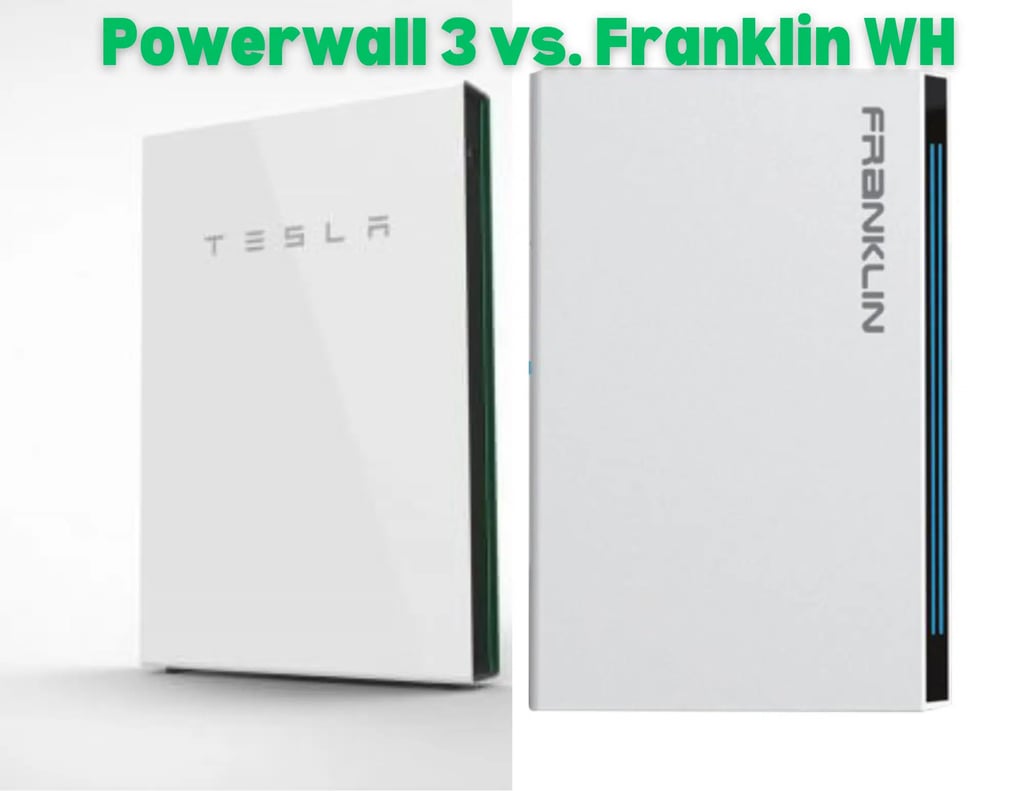
The home battery market has evolved dramatically over the past two years, and homeowners now face a critical decision: which battery system offers the best combination of capacity, power, warranty, and ease of use? Two systems consistently dominate conversations among energy-conscious homeowners—FranklinWH's aPower 2 and Tesla's Powerwall 3. Both systems promise whole-home backup, solar integration, and long-term energy savings, but they take distinctly different approaches to achieving these goals.
This comprehensive comparison examines the technical specifications, warranty coverage, installation complexity, pricing, and real-world performance of both systems to help you make an informed decision for your 2026 home energy investment.
FranklinWH aPower 2: Technical Specifications & Performance
The FranklinWH aPower 2 represents a significant upgrade from the company's previous generation, introducing substantially increased capacity and power output while maintaining the reliability that has made FranklinWH a trusted name in home energy storage.
Energy Capacity & Power Output
The aPower 2 delivers 15 kWh of usable capacity (16 kWh total), representing a 10% increase over the previous 13.6 kWh model. More impressively, the continuous power output has doubled to 10 kW, with peak power reaching 15 kW for 10 seconds. This substantial power increase means a single aPower 2 unit can simultaneously power multiple high-demand appliances—central air conditioning units up to 5 tons, electric stoves, pool pumps, and well pumps—without requiring multiple battery units.
Battery Chemistry & Efficiency
FranklinWH utilizes Lithium Iron Phosphate (LFP) chemistry, which offers superior safety, longevity, and thermal stability compared to traditional nickel-based lithium batteries. LFP chemistry is inherently safer, with lower fire risk and better performance in extreme temperatures. The aPower 2 achieves a 90.5% round-trip efficiency, meaning approximately 90.5 cents of every dollar of energy stored is available for use—a competitive efficiency rating in the industry.
Warranty & Durability
FranklinWH leads the market with an industry-leading 15-year warranty, compared to the 10-year warranty offered by Tesla. The warranty covers the battery unit against defects and guarantees that the system will retain at least 70% of its original capacity at the end of the warranty period. Additionally, FranklinWH backs the aPower 2 with a 60 MWh throughput allowance, providing exceptional protection for high-usage scenarios. This extended warranty reflects FranklinWH's confidence in the system's durability and represents significant long-term value for homeowners planning to stay in their homes for 15+ years.
System Scalability
The aPower 2 supports up to 15 units per system, enabling total capacity of 225 kWh—far exceeding the needs of most residential applications. This scalability provides flexibility for future expansion without requiring complete system replacement.
Tesla Powerwall 3: Technical Specifications & Performance
Tesla's Powerwall 3 represents the company's latest generation of home battery technology, built on years of real-world deployment experience and refined through continuous software updates.
Energy Capacity & Power Output
The Powerwall 3 provides 13.5 kWh of usable capacity, slightly less than the FranklinWH aPower 2. However, Tesla compensates with higher continuous power output of 11.5 kW, exceeding FranklinWH's 10 kW by 1.5 kW. Peak power reaches 11.5 kW for 10 seconds. For most residential applications, this power differential is negligible—both systems can handle typical home loads comfortably.
Battery Chemistry & Efficiency
Tesla utilizes a proprietary nickel-based lithium chemistry optimized for high power delivery and rapid charging. The Powerwall 3 achieves approximately 90% round-trip efficiency, comparable to the FranklinWH system. Tesla's integrated thermal management system maintains optimal operating temperature across a wide range of environmental conditions, from -20°C to 50°C.
Warranty & Durability
Tesla offers a 10-year warranty covering the battery unit, guaranteeing 70% capacity retention. While the warranty period is five years shorter than FranklinWH's offering, Tesla's warranty covers unlimited charge cycles, meaning there are no restrictions on how frequently you use the battery. The Powerwall 3 includes Tesla's proprietary software that continuously optimizes battery health, potentially extending real-world lifespan beyond the warranty period.
System Scalability
The Powerwall 3 supports up to 4 units per system (54 kWh total capacity), providing adequate expansion for most residential applications. While less expansive than FranklinWH's 15-unit capability, the 4-unit maximum is sufficient for comprehensive whole-home backup in virtually all residential scenarios.
Quick Comparison: FranklinWH vs Tesla Powerwall 3
Usable Capacity: FranklinWH (15 kWh) vs Tesla (13.5 kWh)
Power Output: Tesla (11.5 kW) vs FranklinWH (10 kW)
Battery Chemistry: FranklinWH uses LFP (Safer & Longer Life) vs Tesla's Nickel-based Lithium.
Warranty: FranklinWH wins with 15 Years vs Tesla’s 10 Years.
Scalability: FranklinWH can connect up to 15 units (225 kWh) while Tesla supports 4 units (54 kWh).
Generator Support: FranklinWH has Native Support (Direct connect) vs Tesla’s limited support.
Warranty Analysis: The 15-Year Advantage
Warranty coverage represents one of the most significant differentiators between these two systems. FranklinWH's 15-year warranty versus Tesla's 10-year warranty translates to tangible financial benefits for long-term homeowners.
Over a 15-year ownership period, the FranklinWH aPower 2 provides warranty coverage for the entire duration, while the Powerwall 3 warranty expires after 10 years, leaving the final 5 years unprotected. For homeowners planning to remain in their homes for 15+ years, this extended warranty provides peace of mind and potential cost savings if battery degradation or defects occur after year 10.
Additionally, FranklinWH's 60 MWh throughput allowance is exceptionally generous. For a household using the battery daily, this allowance typically covers 15+ years of operation, effectively guaranteeing battery performance throughout the warranty period regardless of usage intensity.
Ease of Use & Installation Complexity
FranklinWH aPower 2 Installation
The FranklinWH aPower 2 features a hybrid architecture with an integrated solar inverter, simplifying installation by eliminating the need for a separate external inverter. The system includes the aGate controller, which manages all energy flows—solar production, battery charging/discharging, grid interaction, and backup power. The aGate's intelligent load management can often eliminate the need for a separate critical loads subpanel, reducing installation complexity and cost.
Installation typically requires 2-3 days for a standard residential application. The system's modular design allows for straightforward expansion if additional capacity is needed in the future.
Tesla Powerwall 3 Installation
The Tesla Powerwall 3 features a DC-coupled architecture, meaning solar panels connect directly to the battery via DC wiring, improving efficiency by reducing energy conversion losses. This design simplifies the electrical architecture and reduces the number of components required.
Installation typically requires 1-2 days for a standard application. Tesla's streamlined design and integrated backup gateway minimize installation complexity. However, whole-home backup may still require a critical loads subpanel in some installations, adding installation time and cost.
User Interface & Monitoring
Tesla's mobile app is widely praised for its intuitive design and real-time monitoring capabilities. The app provides detailed insights into energy production, consumption, and battery status with an elegant, user-friendly interface.
FranklinWH's mobile app is functional and provides comprehensive monitoring data, though the interface is slightly less polished than Tesla's offering. The app includes advanced features like load prioritization and time-of-use optimization, which may appeal to technically sophisticated users.
Pricing & Financial Analysis
FranklinWH aPower 2 Pricing
A single FranklinWH aPower 2 system with aGate controller typically costs $14,000 to $17,500 installed before incentives. This pricing includes equipment, installation labor, permitting, and system configuration. The integrated solar inverter often reduces total system cost compared to systems requiring separate external inverters.
Tesla Powerwall 3 Pricing
A single Tesla Powerwall 3 with backup gateway typically costs $12,500 to $16,500 installed before incentives. This pricing includes equipment, installation labor, permitting, and system configuration. Additional electrical work (panel upgrades, critical loads subpanel) can add $1,500-$5,500 to the total cost.
Incentives & Net Cost
Both systems qualify for the federal 30% Investment Tax Credit (ITC), reducing net cost by approximately $3,000-$5,000 depending on total system cost. Some states and utilities offer additional rebates ($500-$1,500), further reducing net cost.
After federal incentives, net installed cost typically ranges from $7,000-$12,000 for either system, making the financial comparison relatively close. The decision should focus on capacity, warranty, and long-term value rather than upfront cost alone.
Performance in Real-World Scenarios
Scenario 1: Whole-Home Backup During Grid Outage
Both systems can provide whole-home backup power, though the FranklinWH aPower 2's higher capacity (15 kWh vs 13.5 kWh) provides approximately 11% longer runtime for identical loads. For a typical home consuming 1 kW average power during an outage, the FranklinWH provides approximately 15 hours of backup compared to Tesla's 13.5 hours.
Scenario 2: Time-of-Use Arbitrage Under NEM 3.0
Under California's NEM 3.0 net metering rules, both systems excel at capturing solar energy during peak production hours and discharging during peak rate hours (typically 4-9 PM). Both systems can generate $800-$1,200 in annual savings through time-of-use arbitrage, depending on local electricity rates and household consumption patterns.
Scenario 3: Solar Integration & Efficiency
The FranklinWH aPower 2's integrated solar inverter (hybrid architecture) provides slightly higher efficiency than the Powerwall 3's DC-coupled design, though the difference is marginal (90.5% vs 90%). For most homeowners, the efficiency difference translates to less than $50 annually in additional savings.
Conclusion: Which System Is Right for You?
Choose FranklinWH aPower 2 if you prioritize:
•Maximum energy capacity (15 kWh)
•Longest warranty coverage (15 years)
•Generator integration capability
•Scalability to 225 kWh total capacity
•Simplified installation (integrated solar inverter)
Choose Tesla Powerwall 3 if you prioritize:
•Slightly higher continuous power output (11.5 kW)
•Established brand with extensive real-world deployment
•Superior user interface and mobile app
•Faster installation timeline
•Proven track record and widespread installer availability
Both systems represent excellent investments in home energy independence for 2026. The FranklinWH aPower 2 edges ahead for long-term value through its extended warranty and higher capacity, while the Tesla Powerwall 3 offers proven reliability and superior user experience. Your final decision should align with your specific energy needs, budget, and long-term homeownership plans.